When does German statutory health insurance pay for orthodontic treatment, and what does it cover? In this video we explain the KIG classification – the system the statutory insurers use to grade how severe a malocclusion is.
What is the KIG classification?
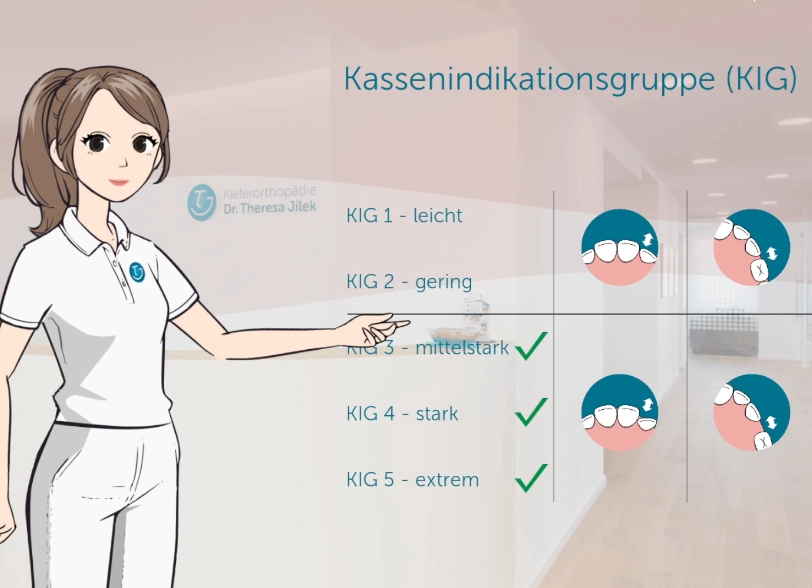
KIG stands for “Kassen-Indikations-Gruppe”, the insurers’ indication group. It runs from grade 1 to 5: the higher the grade, the more severe the misalignment. Statutory insurance only covers orthodontic treatment from KIG 3 to 5. So there are patients who need treatment but receive nothing from their insurer because they are graded KIG 1 or 2.
Basic treatment and optional services
The insurer pays for a basic treatment that is “sufficient, appropriate and economical”. New scientific methods and modern materials are often not part of it. Every patient can choose services beyond the basic treatment at their own expense – known as optional or private services. There is no obligation to do so.
Approval by the insurer
Treatment has to be approved by the insurer before it starts. We send a treatment plan, which the insurer either approves or passes to an expert reviewer, who approves it – with changes if needed – or, rarely, rejects it. Once the plan is approved, treatment can begin.
Everything about costs and insurance is on our prices & insurance page.